
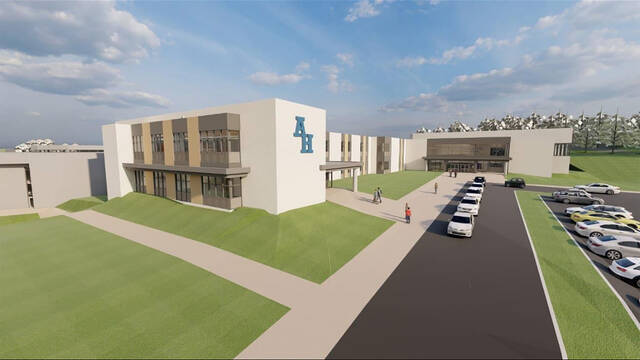
An architectural rendering of the new Abington Heights Middle School.
Submitted Artwork
The Abington Heights School District recently broke ground for the expansion of the Abington Heights Middle School.
According to Newspapers.com, during the early 1970s, the Abington Heights School District embarked on a major building program that included a new junior high school. The total district expansion costs were frequently cited between $8 million and $10 million.
The architectural firm of Bellante, Clauss, Miller, and Nolan was included in the “Notice to Bidders” on Aug. 17, 1973. This time period was when the contracts for general construction, electrical, and plumbing were awarded.
The project was funded through multi-million-dollar bond issues. Newspaper articles from 1972 mention the school board navigating the financial arrangements to cover the rising costs of labor and materials.
KCBA Architects is the architecture firm for the Abington Heights Middle School expansion. Construction contractors were selected through a competitive public bidding process.
The total project cost is approximately $48.5 million, funded through general obligation bonds.
The expansion is projected to be completed by fall 2027.
Christopher Shaffer, superintendent of the Abington Heights School District, explains the need for the expansion.”
• “The school needs to be expanded because the building is outdated. Classrooms are undersized, accessibility is limited, and the facility does not meet modern safety and educational needs. More specifically, the expansion will address educational inadequacies that require remediation. The original design was for open-pod classrooms without walls. Classroom pods are now subdivided, resulting in inadequate environments.”
• Teaching methods are limited because of the size of the rooms and the small number of classrooms.
• The music, art, and STEM classrooms are all outdated and need to be reconfigured.
• “The total building area at the existing school is undersized for the number of students currently enrolled at 1106.
The seventh and eighth grades will move to the new addition. The Abington Heights Middle School offices, small groups, classrooms, and flexible instructional learning spaces will move into the new addition.
The new addition will also have a secure main entrance, modern classrooms, STEM labs, a larger gymnasium, improved accessibility, updated safety features, flexible learning spaces and better traffic flow.
Some of the vacated spaces in the existing middle school will be renovated and used for fifth and sixth grade classrooms, art rooms, music rooms, STEM spaces, and student support areas.
“The students and staff benefit with the new addition from safer entry points, better classroom spaces, improved multi-use instructional areas, modern technology and more efficient movement through the building,” said Shaffer.
Caitlin Graham has a child at Waverly Elementary in the Abington Heights School District.
“I am very excited about the middle school expansion,” she said. “I have heard from many parents who have or had children in middle school that the remodeling and expansion was desperately needed, so I am glad that something is being done about it. I feel confident that it is worthy investment into giving our children a quality education and also increasing their safety while at school.”
Traffic changes at the middle school include revised parent drop-off and pick-up areas, separate bus traffic zones, improved parking, a new paved and lighted road on the west end of campus, and safer pedestrian routes.
Jack Cartegna is 12 years old and in sixth grade at the Abington Heights Middle School. Here is his view on the expansion:
“I think it will be great and hopefully give the middle school population more space. The current situation is very cramped and some of the classrooms are simply partitioning boards in between the established classrooms. My room, for example, has no windows in it and I am hoping the new middle school will have windows in the rooms and feel less congested overall. The building itself works but is old. The lack of space is most noticeable during lunch when there are a million kids in one room, so it’s overcrowded and it feels by the time you get your food, you have no time to eat it.”
“The community feedback has included questions about safety, traffic, cost and classroom use, with overall support expressed during public meetings and school community surveys. The expectation is that the addition will provide a safer, more modern and more effective learning environment for students, faculty, staff and community. District leaders are most looking forward to improved safety, updated learning spaces and a building that supports students and staff doe many years to come,” said Shaffer.


